Too many UX candidates?

I help you hire the best UX designer from your existing pool of candidates in 6 hours

50, 100, 200 or more applicants? I see this a lot in UX. The hiring process clogs up, and you're going to lose the top 10% of candidates along the way.

  • I take over the assessment of all of the applicants
  • With my experience and assessment system, I quickly identify the top 3
  • You prevent losing the top 10% and you hire the best match in 3 weeks
  • You prevent losing the top 10%, and you hire the best match in 3 weeks

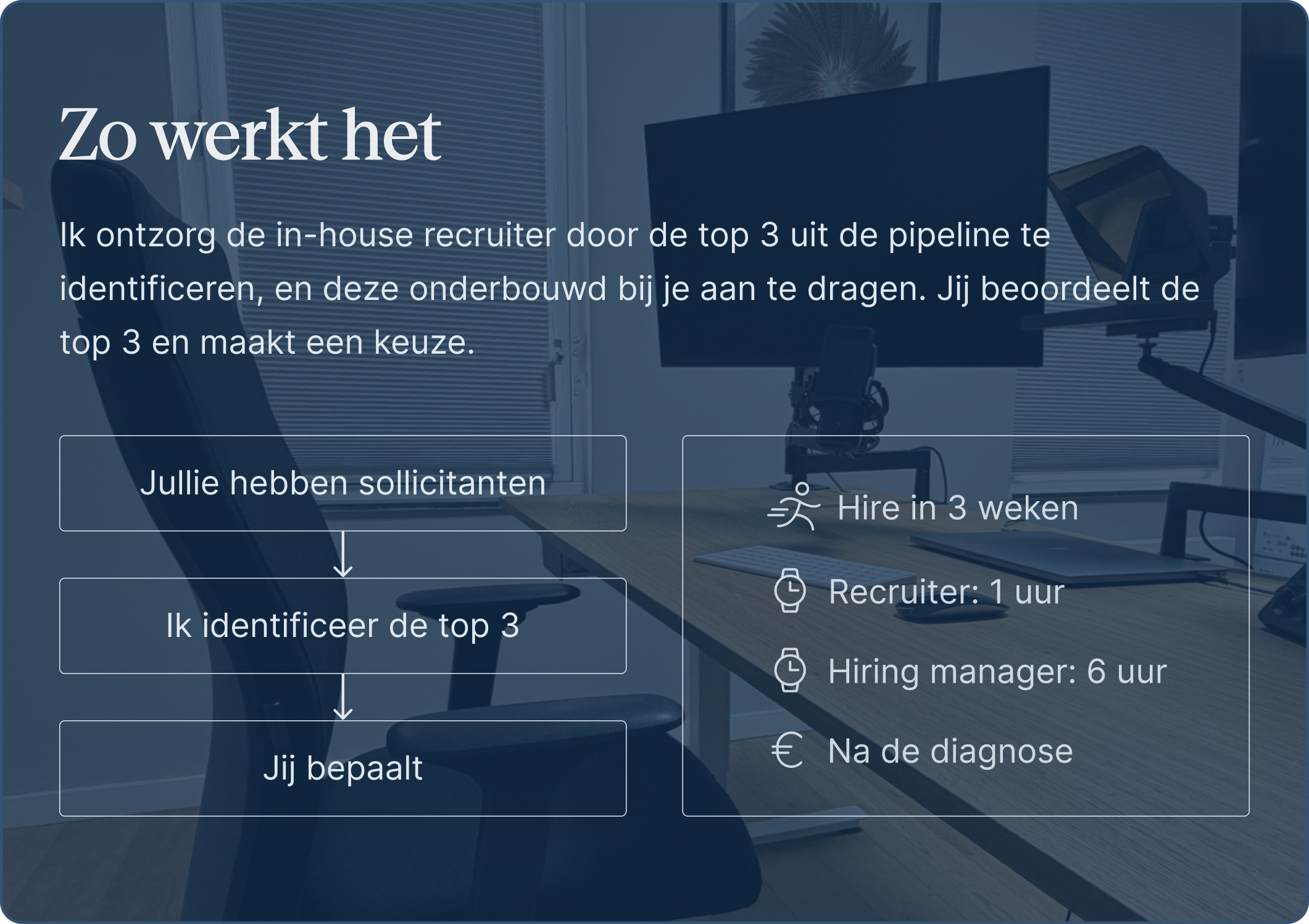
I identify the top 3 in the current pipeline

I assess each individual candidate with my UX designer assessment system.

You only have to decide on the top 3

You prevent losing the top 10%, and you hire the best match in 3 weeks.

I've helped over 300 organisations

SaaS start-ups, scale-ups, agencies and national and international organisations.

+300 other organisations

UX designer qualification

Hire the right UX designer from your pool of applicants, in 6 hours of your time

Many candidates, but only a few are worth it. Sadly those are typically the ones that get lost when hiring teams have many applicants. I’ll identify the top 3 quickly, and help you hire them before they exit the pipeline.

Hoe het mogelijk is dat ik je kan helpen om de juiste UX designer aan te nemen, in 6 uur van je tijd?

Two careers

The basis of my success is that I've had a career in UX as well as talent acquisition.

Out of the 48 years I've spent on this planet, I've spent 20 as a UX, UX/UI, and Product Designer. In executive and in strategic lead roles.

I worked as a permanent employee for 10 years and as a freelancer for 10 years. I worked for agencies and directly for organisations. For example, for Philips, Schiphol, Port of Rotterdam, Rabobank, Adidas, Ultimaker and Centraal Beheer. But also for various SaaS start-ups and scale-ups. I also had a role as a manager within an agency.

In almost every organisational context and almost every design context, I have been able to perform UX design roles.

In those 20 years, I never met a recruiter who really understood the UX roles and the archetypes within them. I went through all sorts of things. Including a complete mismatch that I only found out during my first week of work. Many professionals and managers around me also said that the UX field and its roles are difficult for recruiters to understand.

In 2019, I decided to disrupt the UX hiring world.

I ended my career as a designer and started my second career, a career as a talent acquisition expert.

I have been providing UX talent for permanent roles and temporary hiring full-time for 7 years now, and all this time I have been developing and refining my UX designer assessment method.

In the meantime, I've helped over 300 organisations and I've qualified more than 15,000 UX, UX/UI, and Product designers.

Only tailor-made candidates

I won't give you a list of recycled candidates who I share with multiple parties. For every hiring project, for permanent and temporary positions, I recruit tailor-made candidates, with a vacancy that I develop tailored to your target audience.

That is why I prefer to talk about applicants rather than candidates, because when I propose a professional to you, it is always someone who has actively applied for a vacancy developed for you and has already had a (technical) interview with me personally.

More professional assessment method

UX designers are strategic product designers.

In fact, you can only properly assess the work and approach of a strategist and the work and approach of a product designer if you have more experience with them than the person you're reviewing.

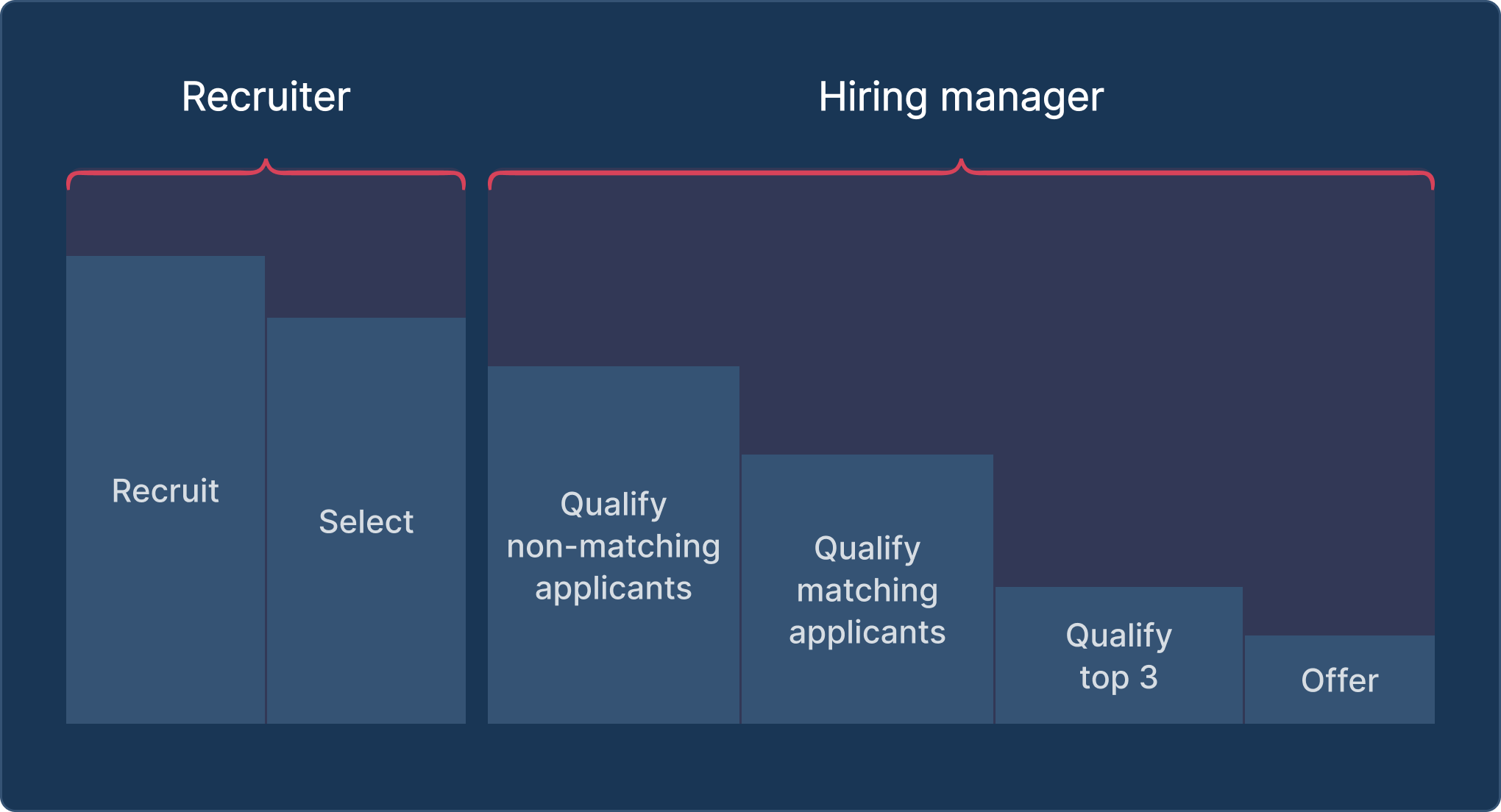
Most recruiters have no experience as UX designers. That is why they are forced to leave the qualification of UX designers to the hiring manager. This is one of the three main factors that, in a recruiter-first setup, hiring managers often spend a lot of time screening and interviewing unsuitable candidates and are at greater risk of mis-hires.


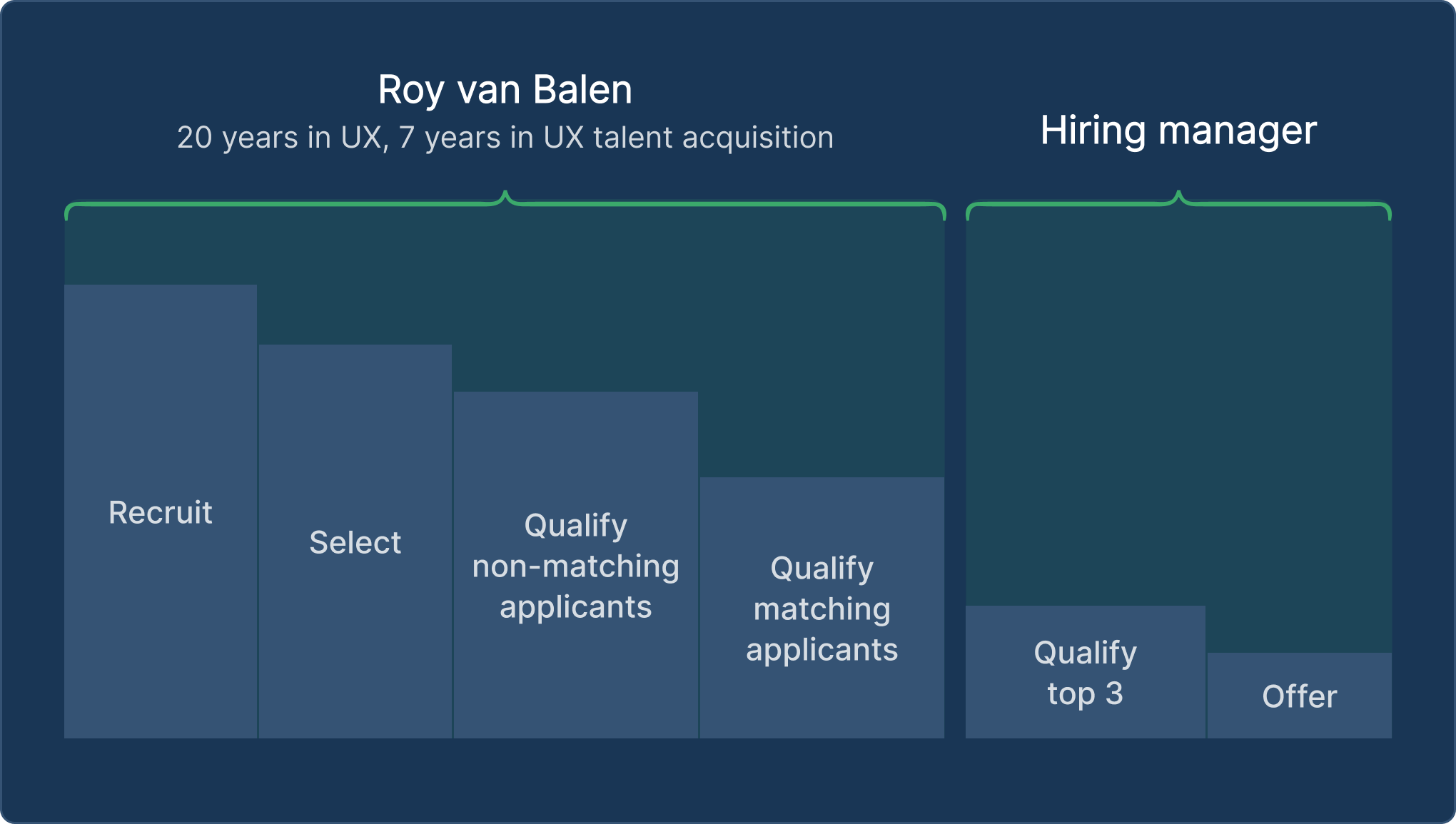
I myself had 20 years of strategic UX, UX/UI and Product design roles, and 7 years of experience as a talent acquisition expert. I've helped over 300 organizations and qualified more than 15,000 UX professionals. In contrast to the traditional recruiter, I can qualify candidates in a high-quality way. This allows me to relieve hiring managers more completely.

For my clients, the process remains the same. After I have presented candidates with substantiation, candidates go through a few steps internally, provided they are invited. And the hiring manager remains responsible for validating the candidates.

However, the candidate quality is much higher, so that the hiring manager can and dares to decide faster.

No closed doors

Unfortunately, recruiters are not equipped to determine to what extent the work history, portfolio and way of working of UX designers matches the design context in which they will be working.

In addition, they often have quantitative targets. Their primary goal is then to achieve a placement, not a certain matching percentage. And, if you have to work with a recruitment agency, the recruiter you work with often gets a substantial bonus if they manage to place someone with you.

This whole thing (not being equipped + quantitative/financial incentives) has led to sales-like wrongdoing, where recruiters try to place designers on jobs they don't match for in order to secure their bonus. This results in many problems, including trust issues, which is not pleasant for both the UX designer and the hiring manager.

That is why the top of the market, the experienced UX designers who are in demand, often keep the door closed to recruiters in principle. When a recruiter approaches them with a vacancy, they are often initially skeptical; they don't easily take on anything from a recruiter. Especially if the vacancy is a generic UX vacancy written by AI, because that means that the recruiter can fill it out himself during the interview.

My primary focus is a qualitative match. That's why I always write vacancies that are as specific as possible, don't use pushy sales practices, and am known for my objective matchmaking.

Because I myself have a background in UX, I can assess and express from my own experience whether a vacancy could be an interesting next step for a professional in a certain situation.

The top of the market is happy to talk to me.

Higher average candidate quality

The quality of candidates in a UX recruitment process is determined in the first steps of the process. If you work with a recruiter, the candidate quality, and thus the quality of your team, is largely determined by someone who is not substantively equipped for it.

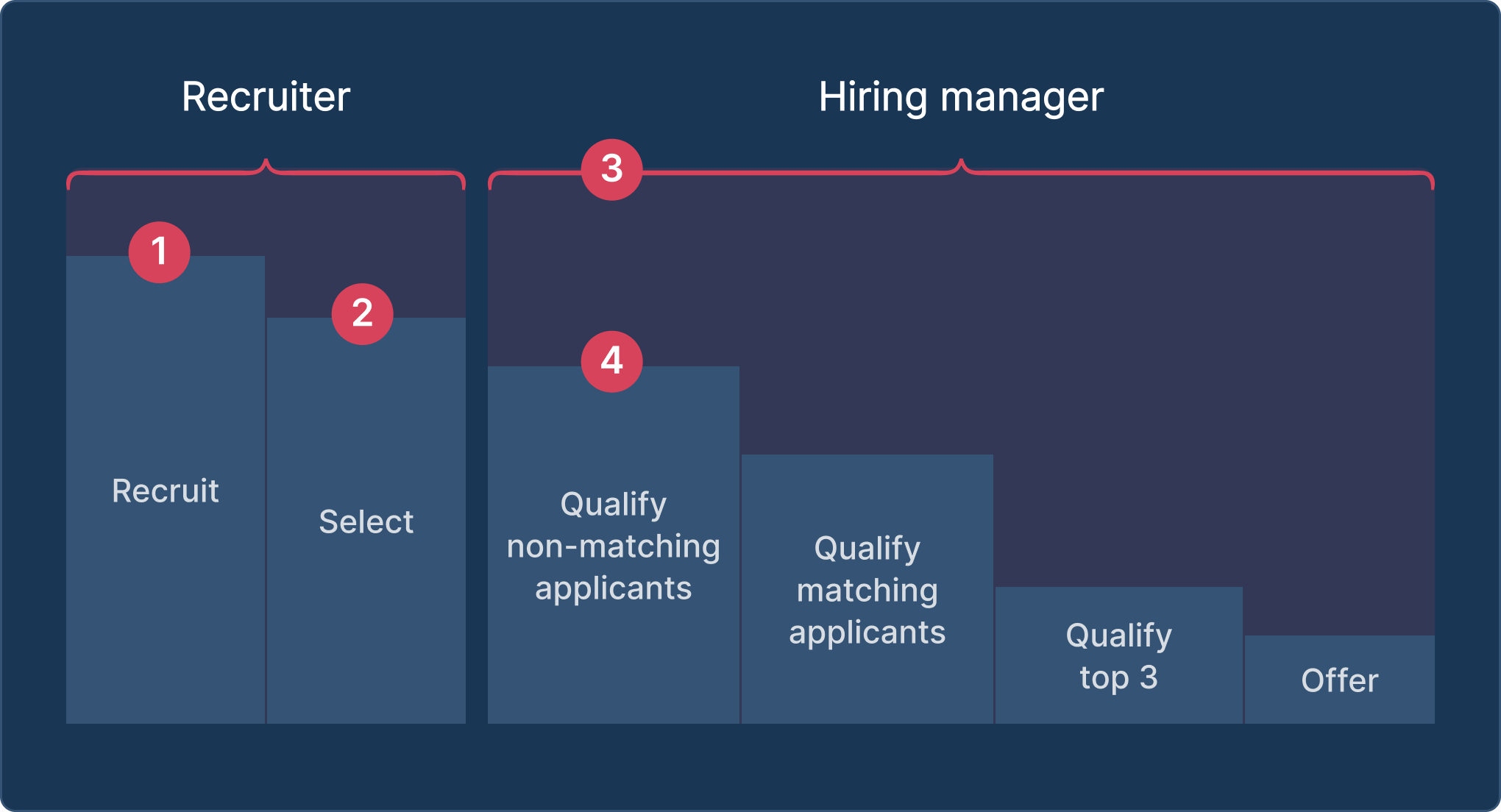
1. Generic vacancy

When recruiters recruit, this often happens with generic (AI-written or not) UX vacancies. Such a vacancy mainly lists tasks. “You're going to make prototypes” is similar to putting a chef in a vacancy: “You're going to bake meat”. It says little about level, context or impact. This has a direct impact on the type of professionals who respond.

2. Eligible candidates will be lost

Candidates of varying quality often respond to generic UX vacancies. Suppose 100 applicants. If the recruiter forwards 10, that means 90 percent will be rejected. The recruiter therefore does most of the content selection. While there is often not the right expertise there. As a result, suitable candidates are regularly missed, ignored or unfairly rejected.

3. Lists of candidates to choose from

Recruiters often work with lists that are shared more widely. Lists of generic candidates that are currently available. The same list goes to several organizations, hoping that someone will stick around somewhere. A “shooting from the hip” approach focused on speed and volume, not a sustainable match.

4. Wide variation in candidate quality

Because a recruiter cannot properly qualify UX designers, he is forced to forward a relatively large number of candidates. The assessment of these candidates will then still be submitted to the hiring manager. He usually has limited time for that. The process slows down, becomes viscous, and in the meantime, the best candidates are also dropping out. Sometimes because they drop out themselves, sometimes because they already get an offer elsewhere. The longer it takes, the more the average candidate quality declines.

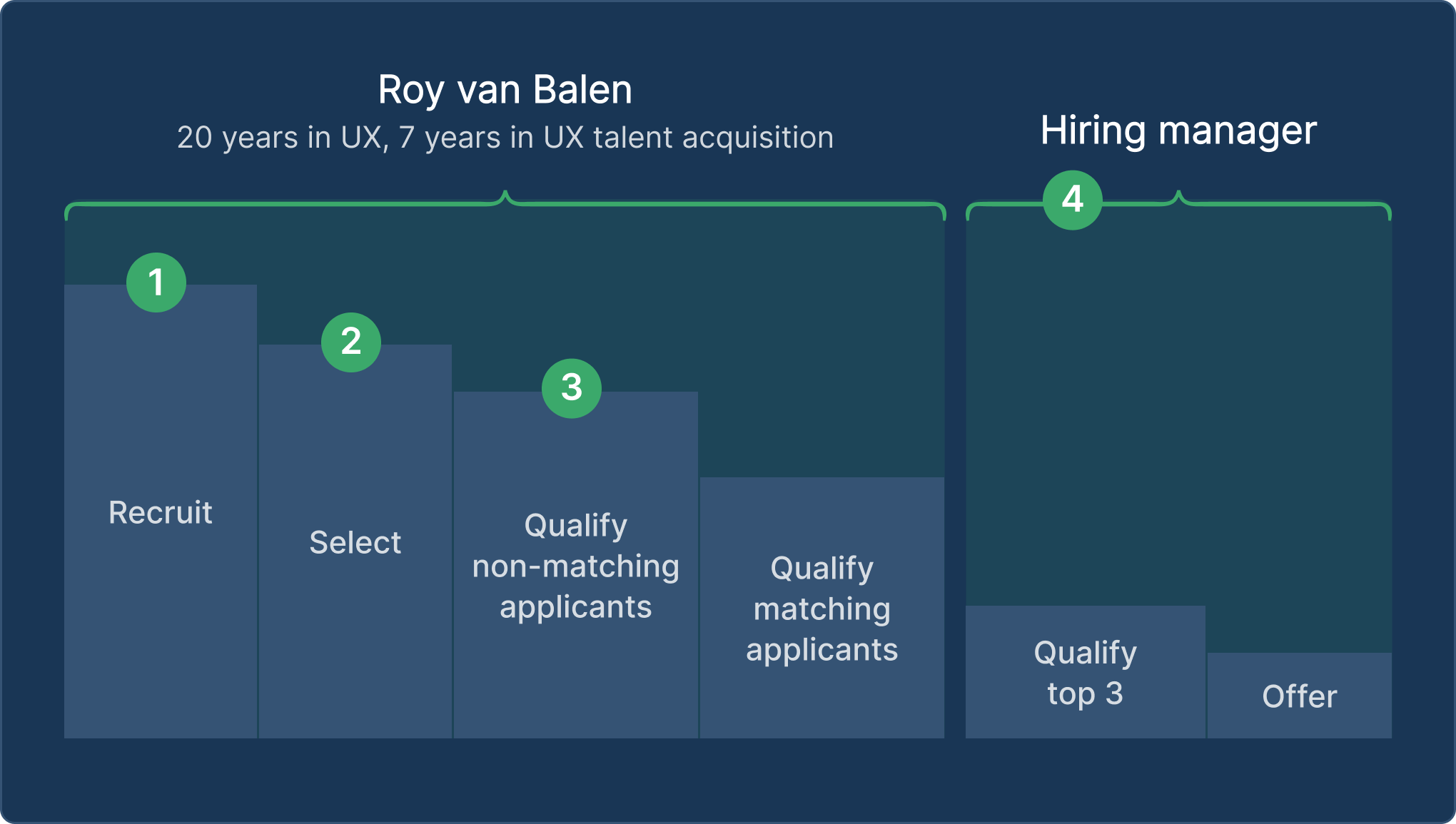
If I help you, candidate quality is determined by someone with 20 years of experience in the field and 7 years in UX talent acquisition.


1. Specialist vacancy

For both permanent roles and temporary hiring, I always develop a customized vacancy. No list of tasks, but a clear picture of what the specific type of UX designer you're looking for is interested in. Focused on context, impact and content.

2. Your own method for spotting UX talent

With 20 years of experience in UX and 7 years of full-time focus on recruiting UX professionals, I have assessed more than 15,000 applicants. My qualification method focuses on spotting UX talent at lightning speed. The chance that a suitable candidate will be overlooked is as good as 0.

3. No list of candidates to choose from

You won't get a list of candidates to go through yourself. For each process, I recruit in a targeted manner, with a tailor-made vacancy. That is why I prefer to talk about applicants than candidates. Everyone I recommend has consciously applied for your specific role and has already had a technical interview with me. To minimize dropouts, I introduce a top match as soon as I see it. I'm not waiting to have more than one. In practice, the right candidate is often at the first or second introduction. Sometimes a third party is needed.

4. High-quality matches only

I listen carefully, and I myself have fulfilled almost every UX design role in multiple organizational contexts and product design contexts. I know what it takes in which situation. I do not nominate candidates who do not fit. Not even to reach a top 3. If too few suitable candidates apply, I will investigate what could be the cause. Together, we can then possibly choose, for example, to slightly change the profile.

I only take up viable vacancies

I always do a feasibility assessment upfront.

If a profile is unrealistic or does not suit the market's offerings, I'll advise you and together we'll see what options we see to make the profile more realistic.

If the reward doesn't match the profile you're looking for, I'll advise you how to align it. If you encounter challenges or restrictions internally, for example a salary house, I'm happy to think along with you.

Only if the outline is realistic and the reward is in line with it will I pick up a vacancy.

Better at spotting UX talent

Heading 6

Lorem ipsum by sit amet, consectetur adipiscing elit, sed do eusmod tempor incididunt ut labore et dolore magna aliqua. Ut enim ad minim veniam, quis nostrud exercitation ullamco laboris nisi ut aliquip ex ea commodo consequat. Dis aute irure door in reprehenderit in voluptate velit se cillum dolore eu fugiat nulla pariatur.

Block quote

Ordered list

  1. Item 1
  2. Item 2
  3. Item 3

Unordered list

  • Item A
  • Item B
  • Item C

Text link

Bold text

Superscript

Better at spotting UX talent

Heading 6

Lorem ipsum by sit amet, consectetur adipiscing elit, sed do eusmod tempor incididunt ut labore et dolore magna aliqua. Ut enim ad minim veniam, quis nostrud exercitation ullamco laboris nisi ut aliquip ex ea commodo consequat. Dis aute irure door in reprehenderit in voluptate velit se cillum dolore eu fugiat nulla pariatur.

Block quote

Ordered list

  1. Item 1
  2. Item 2
  3. Item 3

Unordered list

  • Item A
  • Item B
  • Item C

Text link

Bold text

Superscript

UX pipeline scan

(free of charge)

In this call, I review your candidate pipeline together with you. This can be just with you, or together with the in-house recruiter. I will give you an initial assessment of the overall quality, and of how likely it is that a serious top 3 can be identified. After the call, you will know whether a UX Qualification Sprint is the most logical next step for you.

If you are considering working with me, I can send you a quote.

2026: an exciting year

With curling, you can make adjustments. Not in shooting sports. A similar anomaly has larger and more definitive consequences.

In 2025, digital product development went from curling to shooting sports. With AI, you can generate output at lightning speed. But is that output a hit, or a miss?

In 2026, therefore, the extent to which your employees can give AI direction, assess its output, and adjust it will determine whether you benefit from AI or whether damage occurs.

Right now, it's crucial to have the right people at your disposal.

Why recruiter-first hiring doesn't work for UX

Lots of candidates. But only a handful are worth your time.

The best don't apply, get overlooked, or drop out before you can hire them.

Sounds harsh, but in 2026 this is the reality for many organisations.

Here's what I've learned when it comes to hiring high performers in UX:

UX recruitment expert Roy van Balen
Link naar de Linkedin page van UX recruitment expert Roy van Balen

Roy van Balen

20 jaar in UX
7 in UX staffing

Je browser is verouderd
We zien dat je een oude versie van Internet Explorer gebruikt. We raden aan je browser te updaten.